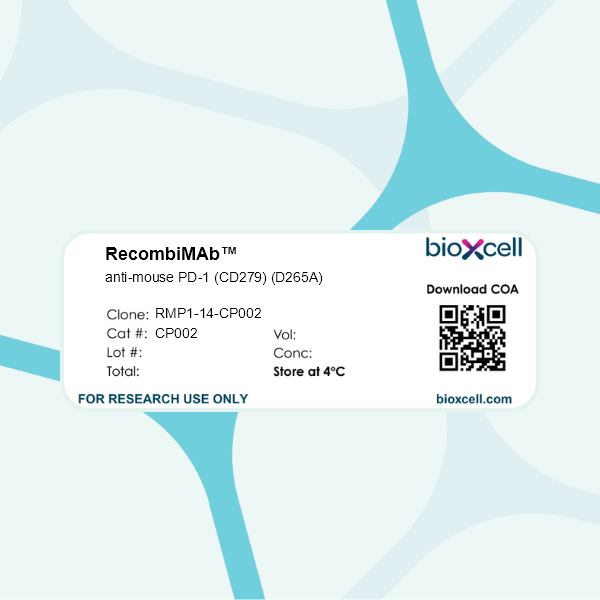

RecombiMAb anti-mouse PD-1 (CD279) (D265A)

Clone Catalog # Category
RMP1-14-CP002 CP002
USD 541 - USD 7325

About RecombiMAb anti-mouse PD-1 (CD279) (D265A)

The RMP1-14-CP002 monoclonal antibody is a chimeric version of the original RMP1-14 antibody. The variable domain sequences are identical to the original RMP1-14 but the constant region sequences have been switched from rat IgG2a to mouse IgG1. The RMP1-14-CP002 antibody also contains a D265A mutation in the Fc fragment rendering it unable to bind to endogenous Fcγ receptors. RMP1-14-CP002 reacts with mouse PD-1 (programmed death-1) also known as CD279. PD-1 is a 50-55 kDa cell surface receptor encoded by the Pdcd1 gene that belongs to the CD28 family of the Ig superfamily. PD-1 is transiently expressed on CD4 and CD8 thymocytes as well as activated T and B lymphocytes and myeloid cells. PD-1 expression declines after successful elimination of antigen. Additionally, Pdcd1 mRNA is expressed in developing B lymphocytes during the pro-B-cell stage. PD-1’s structure includes a ITIM (immunoreceptor tyrosine-based inhibitory motif) suggesting that PD-1 negatively regulates TCR signals. PD-1 signals via binding its two ligands, PD-L1 and PD-L2 both members of the B7 family. Upon ligand binding, PD-1 signaling inhibits T-cell activation, leading to reduced proliferation, cytokine production, and T-cell death. Additionally, PD-1 is known to play key roles in peripheral tolerance and prevention of autoimmune disease in mice as PD-1 knockout animals show dilated cardiomyopathy, splenomegaly, and loss of peripheral tolerance. Induced PD-L1 expression is common in many tumors including squamous cell carcinoma, colon adenocarcinoma, and breast adenocarcinoma. PD-L1 overexpression results in increased resistance of tumor cells to CD8 T cell mediated lysis. In mouse models of melanoma, tumor growth can be transiently arrested via treatment with antibodies which block the interaction between PD-L1 and its receptor PD-1. For these reasons anti-PD-1 mediated immunotherapies are currently being explored as cancer treatments.

RecombiMAb anti-mouse PD-1 (CD279) (D265A) Specifications

IsotypeMouse IgG1, κ
ImmunogenSyrian Hamster BKH cells transfected with mouse PD-1 cDNA
Reported Applicationsin vivo blocking of PD-1/PD-L signaling* *Reported for the original rat IgG2a RMP1-14 antibody
FormulationPBS, pH 7.0 Contains no stabilizers or preservatives
Endotoxin
  • ≤0.5EU/mg (≤0.0005EU/μg)
  • Determined by LAL gel clotting assay
Aggregation<5% Determined by SEC
Purity
  • ≥95%
  • Determined by SDS-PAGE
Sterility0.2 μm filtration
ProductionPurified from HEK293 cell supernatant in an animal-free facility
PurificationProtein G
Molecular Weight150 kDa
StorageThe antibody solution should be stored at the stock concentration at 4°C. Do not freeze.

The Bio X Cell Singapore website will permanently redirect to https://bioxcell.com/ from 30th April 2026.

This transition is designed to streamline access to new products, product data, technical resources, and provide a smoother ordering experience through our unified global platform.

All products, documentation, and customer support will continue to be available at: https://bioxcell.com/

https://bxcell.sg/ will remain active temporarily to support this transition before redirecting automatically.

Please update your bookmarks to https://bioxcell.com/.

For regional support, please refer to https://bioxcell.com/our-distributors.

For Singapore customers, please contact our authorized distributor, Omnicell Pte Ltd:-

eMail : enquiry@omnicell.com.sg ; Tel : 67470201

Website : www.omnicell.com.sg 

Do not show this again [ CLOSE ]